CEng 501 - Deep Learning - Fall 2025

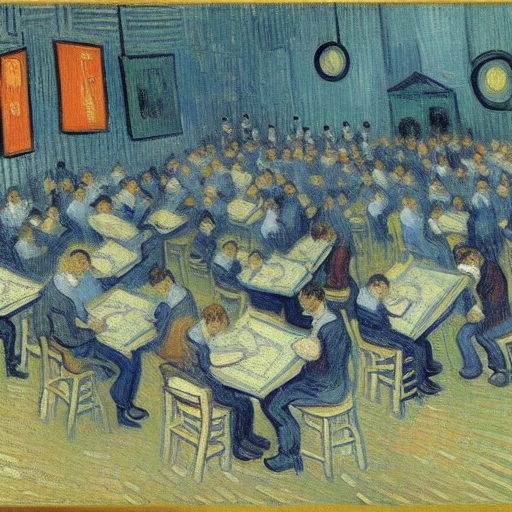

Images generated by the “Stable Diffusion” method. From left to right: “a bunch of students learning deep neural networks” by Picasso, Van Gogh and Da Vinci.
Instructor: Emre Akbas; e-mail: emre at ceng
dot metu.edu.tr; Office: A-403; Office hours: click + by apppointment
Lectures: Thursday 9:40-12:30 at BMB-3
Online communication: (forum, homework submissions) https://odtuclass.metu.edu.tr/
Syllabus: click
here
Announcements
- Oct 6, 2025 - Student with these IDs can add the class during add-drops this week (starting from Monday afternoon). Those who are already registered do not need to do anything.
- Sep 5, 2025 - I am receiving too many e-mails about taking this course as a special student, as an undergrad, from other departments/universities, etc. I am not able to respond each of them. If you want to take the course, please make sure you attend the first lecture. And, please see my answers to frequently asked questions.
Late submission policy
Any work, e.g. an assignment solution, that is submitted late past its deadline will receive -10 points per day delayed. For example, if the deadline is Oct 14, 23:59 and a student submits his/her work anytime on Oct 15, that work will be evaluated over 90 instead 100.
Detailed syllabus
An important note: Lecture slides provided below are by no means a complete resource for studying. I frequently use the board in class to supplement the material in the slides.
Playlist of lecture recordings
Week 1
- Brief introduction and course logistics (slides).
- Recommended reading: “Chapter 4: Numerical Computation” and “Chapter 5: Machine Learning Basics” from the book “Deep Learning.”
Week 2
- Lecture topics: A brief review of machine learning background (slides).
- Hands-on tutorial: developing a basic classifier using hinge loss: Colab notebook
Week 3
- Lecture topics: Artificial neuron, perceptron learning rule, multilayer perceptrons, activation functions, initialization, backpropagation, stochastic gradient descent, momentum (slides).
- Colab notebook on building, training and evaluating a basic MLP.
- Recommended reading: sections 8.1 and 8.3 from “Chapter 8: Optimization for training deep models” from the book “Deep Learning.”
Week 4
- Lecture topics: momentum, adaptive learning rate methods, modular backpropagation, convolutional neural networks (CNNs), AlexNet (slides).
- Colab notebook on building, training and evaluating a basic CNN.
- Recommended reading: LeCun, Y., Bengio, Y., & Hinton, G. (2015). Deep learning. Nature, 521(7553), 436-444.
Week 5
- Lecture topics: implementing a convolutional layer, normalization layers, important CNN architectures, types of convolution, recurrent neural networks (RNNs), backpropagation though time, gated RNNs, GRUs, LSTMs (slides).
- Recommended reading: He, K., Zhang, X., Ren, S. and Sun, J. Deep residual learning for image recognition. In CVPR 2016.
- Colab notebook on implementing a bare-bones object detector.
- HW1 released on ODTUClass.
Week 6
- Lecture topics: sequence modeling, tokenization, token encoding, character and word level language modeling, sequence to sequence encoder-decoder models, attention, self-attention, transformer (slides).
- Recommended reading: “The Unreasonable Effectiveness of Recurrent Neural Networks” by A. Karpathy.
Week 7
- Lecture topics: positional encoding, Vision Transformer (ViT), DeiT, Swin Transformer, sliding window attention, linear attention, flash attention, ViTs for dense prediction, AttentionRollout for visualization (slides).
- Recommended reading: Dosovitskiy et al. An image is worth 16x16 words: Transformers for image recognition at scale. In ICLR 2021.
Week 8
- Lecture topics: self-supervised learning, predictive modeling, agreement-based learning, next word prediction, next sentence discrimination, masked language modeling, masked image modeling, constrastive, non-contrastive, clustering-based, distillation-based SSL methods (slides).
- Recommended reading: Caron et al. Emerging properties in self-supervised vision transformers. In ICCV 2021.
Week 9
- Lecture topics: vision-language models, open-vocabulary, zero-shot recognition, image-caption datasets, CLIP, SigLIP, SAIL, no true zero-shot generalization (slides).
- Recommended reading: Radford et al. Learning transferable visual models from natural language supervision. In ICML 2021.
Week 10
- Lecture topics: deep generative modeling, energy-based models, (restricted) boltzmann machines, autoregressive modeling, variational autoencoders, generative adversarial networks, diffusion (slides).
- Recommended reading: Ho et al. Denoising diffusion probabilistic models. In NeurIPS 2020.
Week 11
- Lecture topics: autoregressive modeling, decoder only Transformer, causal self attention, GPT family (1, 2, 3, InstructGPT, 3.5, ChatGPT), low rank adaptation (LoRA), retrieval augmented generation (RAG), chain of thought (CoT), open LLMs (Llama, Qwen) (slides).
- Recommended reading: Ouyang et al. Ouyang et al. Training language models to follow instructions with human feedback.. In NeurIPS 2022.
Week 12
- Lecture topics: foundation models, multimodal models, conditioning diffusion on text, edge maps, semantics maps, human pose; ways of combining modalities, linear projection in LaVA, querying transformer in BLIP-2, gated cross-attention in Flamingo, Janus-Pro, large multimodal models (slides).
- Recommended reading: Liu et al. Visual instruction tuning. In NeurIPS 2023.
Week 13
- Lecture topics: a brief introduction to deep reinforcement learning, core concepts, REINFORCE, policy-gradient methods, Q-learning, some applications (slides).
- Recommended reading: “Deep Reinforcement Learning: Pong from pixels” by A. Karpathy.
Week 14
- No class (1/1/2026).
Frequently Asked Questions about taking the course
I am receiving too many e-mails about taking the course. Unfortunately, I cannot reply them one by one. Below are answers to common questions.
Q1: Can I take the course?
A1: There is a huge demand for the course from all kinds of backgrounds. Thanks. However, I have the responsibility to evaluate your learning outcomes and grade you. Therefore, I need to limit the number of seats. Based on my previous years’ experience, this limit will be around 35-40.
Since this is a graduate METU CENG course, I need to give priority to the graduate students in our department. Here is the priority order that I will use to accept students to the class. From high to low priority:
- Graduate students from METU CENG, Robotics, AIX, DDS programs,
- A limited number of 4th year undergraduate students from METU
CENG,
- Graduate students from other METU departments,
- Special students (see http://oidb.metu.edu.tr/ozel-ogrenci, you need to be a grad student in some other university to be eligible).
I must note that the first two categories almost fill up the whole capacity. So, unfortunately, there might not be much room for the remaining two categories.
Also, precedence will be given to students who are actively doing research in machine learning and related areas. This course is not a PyTorch or Keras tutorial, we intend to go beyond the “user” level.
You might want to check out the other three DL courses offered in METU: MMI727, EE543, and CENG403.
Machine learning background is required. If you have not taken a machine learning course before, please do not take this course.
Fluency in Python is required.
This course assumes that the student has taken already a course on the fundamentals of deep learning and is familiar with conventional models such as Multi-Layer Perceptrons, Convolutional Neural Networks, Recurrent Neural Networks and Long-Short Term Memory Networks.
Q2: How can I register for the course?
A2: Come to the first lecture. In the first lecture, I will collect information from the participants and then, will decide (based on my answer A1 above) on who will be able to register. This enrollment list will be announced in a couple of hours following the first lecture. Students listed in this enrollment list will be able to add the course during the add-drop period.
Q3: I was able to take the course during the regular interactive registration. Should I worry about not being accepted?
A3: No worries. You will stay.
Q4: Can I take this course as a special student?
A4: Possible but unlikely. Please see my answer A1 above.
Q5: Even if I don’t officially register for the class, can I audit it?
A5: Yes, definitely.